Ancient Walls, Modern Homes: Indian Building Wisdom That's Quietly Transforming American Construction
The Old Ways Are Having a Moment
Walk through any neighborhood in Rajasthan or Kerala and you'll spot something that most American subdivisions quietly lack: buildings that have been standing for three, four, sometimes five hundred years. Not because ancient Indian builders had access to better materials — they didn't have Portland cement or power drills — but because they understood their environment deeply and built accordingly.
That knowledge is crossing the Pacific, carried by Indian-American builders, architects, and passionate DIYers who grew up watching their grandparents slap lime mortar onto stone or weave bamboo into structural panels. And a growing number of American homeowners are paying close attention.
"People kept asking me why my uncle's house in Tamil Nadu was still standing after a cyclone when the newer concrete buildings around it crumbled," says Suresh Venkataraman, a general contractor based in Austin, Texas. "The answer is in the technique. The older construction had flexibility built into it. It wasn't trying to fight nature — it was working with it."
What Exactly Are We Talking About?
Let's get specific, because "Indian building techniques" covers an enormous amount of ground. Here are the methods getting the most traction in American projects right now.
Lime Mortar and Lime Plaster
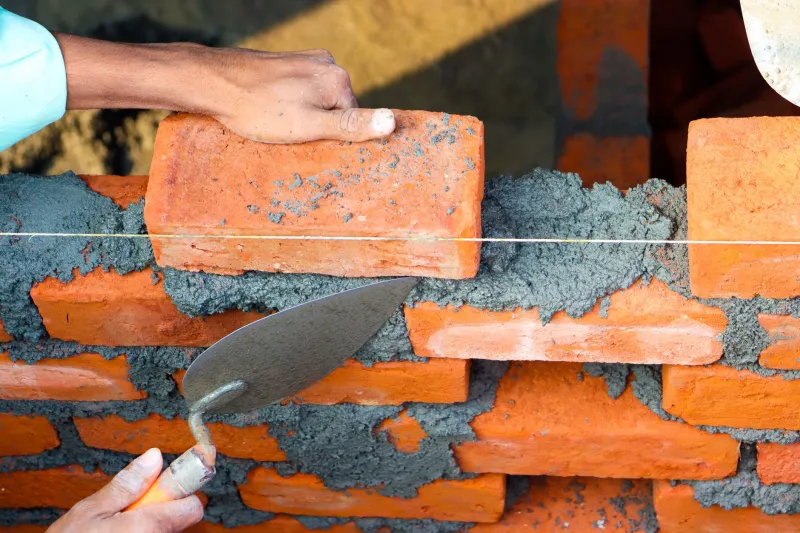
Before cement became the default binder in construction, lime ruled the world — and it still does in traditional Indian building. Lime mortar is softer and more flexible than modern cement mortar, which means it absorbs small structural movements without cracking. It's also highly breathable, letting moisture escape from walls rather than trapping it inside.
For American homeowners dealing with historic homes, basement moisture issues, or just crumbling cement-patched brick, lime mortar is increasingly the go-to fix. It's not exotic — it's actually what most pre-1920s American buildings were built with too. Indian builders just never stopped using it.
Rat-Trap Bond Brickwork
Developed and popularized by the legendary Indian architect Laurie Baker, rat-trap bond is a bricklaying pattern where bricks are laid on their sides, creating hollow cavities within the wall. The result? Walls that use 25% fewer bricks, provide better thermal insulation, and are significantly lighter without sacrificing structural strength.
Jaspreet Dhaliwal, a builder in Fresno, California, started experimenting with rat-trap bond on garden walls and outbuildings three years ago. "My clients thought I was making it up at first," he laughs. "Then they saw their energy bills drop and they stopped asking questions."
Madras Terrace Roofing
This technique, originating in South India, uses a combination of brick, lime concrete, and reinforcement to create flat roofs with exceptional thermal mass. Unlike standard American flat-roof construction, a properly built Madras terrace roof stays cooler in summer and warmer in winter naturally, without heavy insulation. Several eco-builders in the American Southwest are now adapting the principle for desert climates where the temperature swings are brutal.
Joinery Without Metal Fasteners
Traditional Indian woodworking — particularly from Kerala and Gujarat — relies heavily on interlocking joints that require no nails, screws, or metal hardware. Mortise-and-tenon variations, dovetail joints, and wooden pin systems create connections that actually strengthen over time as the wood settles. American furniture makers have long admired Japanese joinery, but Indian joinery traditions are equally sophisticated and, frankly, less talked about.
The Eco-Conscious Building Connection
Here's why this conversation is happening right now specifically: the sustainable building movement in the United States has been looking for alternatives that go beyond recycled content percentages and LEED certification points. People want construction philosophies that are genuinely low-impact, not just greenwashed.
Traditional Indian building techniques check a lot of those boxes. Lime is made from limestone and returns to limestone over time — it's fully recyclable. Rat-trap bond reduces material use without compromising performance. Bamboo, used extensively in Indian construction, grows back in three to five years versus sixty-plus for hardwood timber.
Renuka Sharma, an architect in Portland, Oregon, has been incorporating these principles into her residential projects for six years. "My clients are coming to me because they want something that feels intentional," she says. "These techniques carry a story. They weren't invented in a lab — they evolved over generations of people figuring out how to build well with what they had. That resonates with people who care about where their materials come from."
Getting Started: What You Can Actually Do This Weekend
You don't need to rebuild your house to start exploring these approaches. Here are some practical entry points:
-
Repair brick or stone with lime mortar instead of cement. It's more forgiving to work with, looks better on older masonry, and you can find pre-mixed lime mortar at most well-stocked hardware stores. At Shree Ram Hardware, we carry several formulations suited to different applications.
-
Try a simple mortise-and-tenon joint on your next woodworking project. There are excellent tutorials available, and the tools required — chisels, a mallet, a marking gauge — are basic and affordable. The skill, once learned, changes how you think about wood.
-
Experiment with thermal mass. Even something as simple as using thicker tile or stone flooring in a sun-facing room can demonstrate the principle of thermal mass that underlies so much traditional Indian building. Feel the difference on a cold morning.
-
Look into bamboo for fencing, garden structures, or interior accent walls. Bamboo is increasingly available in the US market, and working with it teaches you a lot about material flexibility.
Respect, Not Appropriation
One thing worth saying clearly: adopting these techniques works best when it comes with genuine curiosity about their origins and context. The builders we talked to for this piece all emphasized that understanding why a technique works — the climate it was developed for, the materials that were locally available, the lifestyle it was designed to support — makes you a better builder, not just someone copying an aesthetic.
"The technique is the surface," says Suresh Venkataraman. "The thinking behind it is what you really want to learn."
At Shree Ram Hardware, that's a philosophy we recognize. Building better isn't just about buying the right nail — it's about understanding what you're building, why you're building it, and how to make it last. Whether your inspiration comes from a YouTube channel, a job site in Texas, or a grandmother's house in Kerala, the goal is the same: something worth standing in for a long time.