Dead Bolts Don't Lie: What Your Failed Fasteners Are Trying to Tell You
There's a box in a lot of contractors' trucks and a drawer in a lot of garages that nobody talks about. It's full of bent screws, snapped bolts, and fasteners that came out of a project looking nothing like they went in. Most people toss them without a second thought. That's a mistake — and a pretty expensive one.
Those beat-up little pieces of metal are more than trash. They're evidence. And if you know how to read them, they'll tell you exactly where a build went wrong, what you should have used instead, and how to keep the same thing from happening again on your next project.
This isn't just for professionals. DIYers who've tackled a deck, a fence, or a bathroom remodel have their own collection of failed hardware sitting in the recycling bin. Before you throw it out, take five minutes. You might be surprised what you learn.
Start With the Rust Pattern — It's More Specific Than You Think
Not all rust looks the same, and the differences matter.
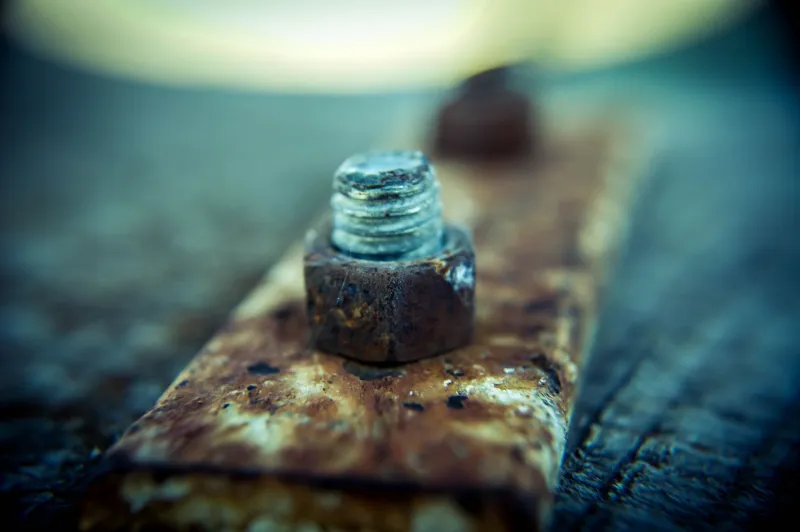
If a fastener has uniform, surface-level rust across the whole shaft, that's usually a coating failure — either the zinc plating was too thin, the fastener wasn't rated for outdoor exposure, or it was stored improperly before installation. This is one of the most common and preventable mistakes in residential construction. A standard interior screw used in an exterior application will look exactly like this after a single winter.
If the rust is concentrated at the head or at the point where the fastener meets the wood, you're looking at a galvanic corrosion issue. This happens when two dissimilar metals — say, a zinc-plated screw in contact with pressure-treated lumber that contains copper-based preservatives — start trading electrons. The result is accelerated corrosion right at the contact point. ACQ-treated lumber, which is extremely common in US decking projects, is particularly aggressive on standard fasteners. The fix is simple: use stainless steel or hot-dipped galvanized fasteners rated specifically for treated wood.
Deep pitting in isolated spots usually points to moisture pooling — a design problem more than a fastener problem. Water is sitting somewhere it shouldn't be, and the fastener is paying the price.
Shear Marks Tell a Mechanical Story
When a fastener snaps rather than pulls out, the break itself is a data point.
A clean, flat shear line — like someone took a hacksaw to it — usually means the fastener was the wrong grade for the load it was carrying. It hit its shear strength limit and gave out all at once. This shows up a lot in deck ledger connections, pergola brackets, and anywhere structural loads are transferred laterally. If you find this on a project, the question isn't just "why did it fail" — it's "what was holding that load before it failed, and is there more of the same hardware still in service?"
A twisted or spiral break is different. That pattern indicates torsional stress — the fastener was being torqued, not just sheared. Over-driving screws with an impact driver, especially into hardwood or composite decking, can set this up. The fastener gets work-hardened from the installation stress and eventually twists apart under load. Matching drive speed to material density and using the right bit size dramatically reduces this.
A fastener that pulled out cleanly, leaving a smooth hole, usually isn't a fastener problem at all. It's a substrate problem. The material it was driven into — whether that's OSB, old pine, or a compromised concrete anchor point — didn't have the holding power the application needed.
A Real Case Study: The Deck That Came Apart After Three Years
Let's walk through an actual scenario that plays out across American suburbs every summer.
A homeowner in the mid-Atlantic region — a climate with hot, humid summers and cold, wet winters — built a pressure-treated pine deck in the spring. They used standard box-store deck screws, the ones with a gold-tinted coating. Three years later, the decking boards are lifting at the edges, a few have cracked, and when they pull some screws out, they're red with rust and several snap during removal.
Forensic read on those screws: the coating is an electroplated zinc finish, not hot-dipped galvanized. It's rated for interior use or very mild exterior exposure. Against ACQ-treated lumber in a humid climate, it lasted about two seasons before the galvanic process ate through the coating. Once the bare steel was exposed, the mid-Atlantic winters did the rest. The swelling and contracting of the wood around a weakening fastener is what lifted the boards.
The fix going forward isn't more screws — it's different screws. Hot-dipped galvanized or type 316 stainless steel, both rated for use with treated lumber, would have held that deck for twenty years without a problem. The price difference per box is maybe eight to twelve dollars. The cost of the failure — replacement boards, labor, and the boards that cracked from freeze-thaw stress — ran well over a thousand dollars.
Build Your Own Fastener Autopsy Kit
You don't need a lab. You need a few basic tools and the habit of looking before you toss.
Keep a small container — a mason jar works fine — where you drop failed or suspicious fasteners from any project you disassemble or repair. Label it with the project and the year. When you've got a few, spend ten minutes with a magnifying glass and decent lighting.
Ask yourself: Where is the corrosion concentrated? Is the metal discolored uniformly or in specific spots? Did it snap, strip, or pull out? What material was it installed in, and was that material treated or untreated? What was the climate exposure?
Cross-reference what you see against the fastener type. If you still have the packaging, check the coating spec. "Electroplated" and "hot-dipped galvanized" are not the same thing, and the label will tell you which you've got.
Over time, this habit builds a personal database of what works and what doesn't in your specific climate, with your specific materials, under your specific conditions. No online article — including this one — can fully replicate that.
The Bigger Lesson: Fasteners Are Not Interchangeable
The hardware industry in the US has thousands of fastener SKUs for a reason. Shank diameter, thread pitch, coating type, material grade, head style — every variable exists because someone, somewhere, needed a specific solution for a specific problem.
The fastener graveyard in your garage isn't a collection of failures. It's a library. Every piece in it represents a real-world test of a material decision under actual conditions. That's more valuable than a spec sheet.
At Shree Ram Hardware, we believe that building better isn't just about buying better — it's about getting smarter with every project you finish. The builders who consistently do great work aren't the ones who never make mistakes. They're the ones who refuse to make the same mistake twice.
So next time you're tearing apart an old project, slow down before you toss those fasteners. They've got something to say. You just have to know how to listen.