Gold in the Junk Drawer: How to Turn Your Chaotic Fastener Collection Into Real Project Savings
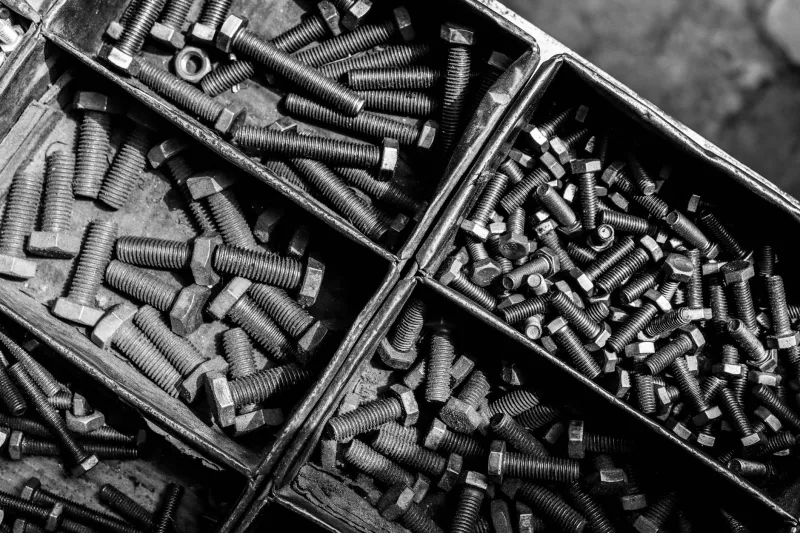
Every serious DIYer and working contractor has one. Sometimes it's a five-gallon bucket. Sometimes it's a shoebox. Sometimes it's three different drawers in a rolling cabinet that you swore you'd organize "next weekend" sometime around 2019. It's the fastener graveyard — a dense, jumbled collection of leftover bolts, orphaned screws, half-empty boxes of nails, and mystery hardware that came with furniture you assembled years ago.
Here's the thing nobody tells you: that pile is money. Literal, spendable money — if you know how to unlock it.
At Shree Ram Hardware, we talk to contractors and weekend warriors every single week who walk in to buy hardware they almost certainly already own. The problem isn't their budget. It's their system. Or more accurately, the complete absence of one.
Let's fix that.
Why You're Buying the Same Screw Twice (And Probably Three Times)
The average American household has somewhere between $50 and $300 worth of miscellaneous fasteners scattered across their garage, workshop, and junk drawers. Contractors can push that number well past $1,000 when you factor in job-site leftovers, bulk purchases with partial usage, and specialty hardware bought for one-off projects.
The reason this stock never gets used isn't laziness — it's friction. When you need a 3/8-inch lag bolt and your hardware is buried in an unlabeled coffee can with 400 other pieces of metal, it's faster and less frustrating to just drive to the store. So you do. And the old lag bolts sit there, untouched, while you pay for new ones.
This cycle repeats until either the pile gets so overwhelming you throw it all away, or someone sits down and actually deals with it. We're going to help you be that someone.
Step One: The Great Sort
Before you can catalogue anything, you need to see what you actually have. Clear a table or workbench completely, grab a few shallow bins or trays, and dump everything out. Yes, everything. Resist the urge to sort as you go — just get it all in one place first.
Once it's spread out, start grouping by fastener type:
- Screws (wood screws, drywall screws, machine screws, sheet metal screws)
- Bolts (hex bolts, carriage bolts, eye bolts, lag bolts)
- Nails (common nails, finish nails, roofing nails, brad nails)
- Nuts, washers, and anchors
- Specialty hardware (joist hangers, hurricane ties, shelf pins, furniture cam locks)
Don't worry about size yet — just get the categories separated. This first pass usually takes 20 to 30 minutes and immediately reveals something surprising: most people have far more usable hardware than they realized, and far fewer true mystery pieces than they feared.
Step Two: Identify the Premium Stuff
Here's where it gets genuinely interesting. Mixed into almost every fastener graveyard are components that are actually high-quality — and expensive to replace.
Look for these indicators of premium-grade hardware:
Coating and finish. Hot-dip galvanized fasteners have a thick, slightly rough zinc coating. Stainless steel hardware has a bright, non-magnetic finish. These are weather-resistant, corrosion-resistant, and significantly more expensive than standard zinc-plated hardware. If you find a handful of these in your pile, they're worth segregating and protecting.
Markings and grades. Structural bolts are often stamped with grade markings — Grade 5 bolts have three radial lines on the head, Grade 8 have six. These are engineered for high-load applications and cost considerably more than standard hardware-store bolts. Don't throw them in with the general population.
Specialty coatings. Ceramic-coated deck screws, epoxy-coated rebar ties, and similar specialty fasteners are easy to overlook but expensive to rebuy. If a screw has an unusual color — green, brown, or bright yellow — it likely has a specific coating for a specific application.
Pull these out and set them aside. They deserve their own storage and their own label.
Step Three: Build a Simple Cataloguing System That You'll Actually Use
The goal here isn't perfection. It's usability. An overly complex system is just a different kind of chaos.
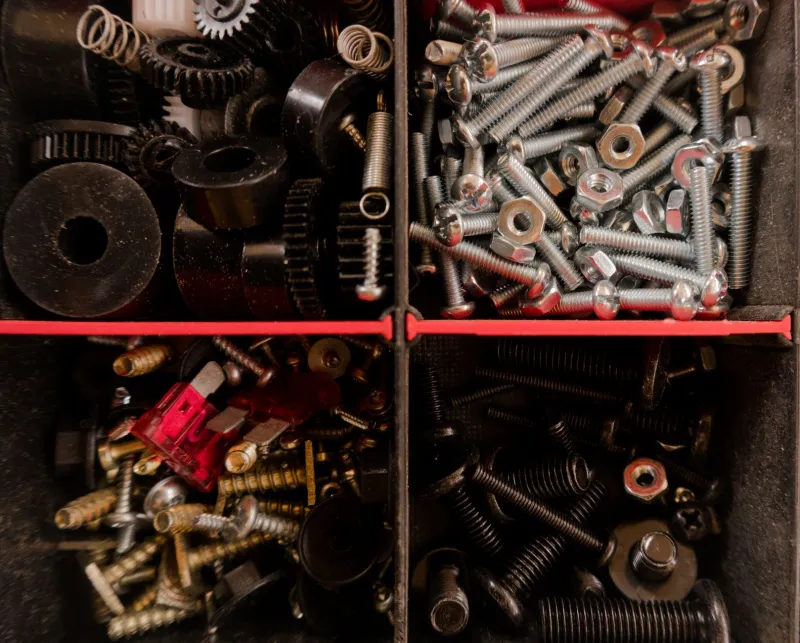
For most DIYers, a basic small-parts organizer from your local hardware store — the kind with clear plastic drawers — is the right tool. Label each drawer with the fastener type, size, and finish. Something like "Drywall Screws – 1-5/8" – Coarse Thread" is enough. You don't need a spreadsheet unless you're running a contracting business.
For contractors managing larger quantities, a simple spreadsheet or even a notes app on your phone works well. Columns for fastener type, size, quantity, finish, and location (which bin or shelf) give you enough information to check your stock before making a supply run.
A few practical tips that make a real difference:
- Use a hardware gauge or caliper to identify unknown screw sizes. A $10 screw gauge from any hardware store eliminates guesswork.
- Store like with like. Mixing sizes is how you end up back at square one.
- Keep a running "low stock" list on the wall or in your phone. When a drawer gets below a handful, add it to the list before you run out.
- Date your bulk purchases. Fasteners don't expire, but knowing when you bought something helps you track usage and plan future orders.
Step Four: Match Your Inventory to Upcoming Projects
Here's where the savings actually show up. Before you start any new project — a deck addition, a bathroom remodel, a fence repair — pull your project's fastener list and cross-reference it against your catalogue.
You might find that half your lag bolts for that deck ledger board are already sitting in drawer three. Or that the finish nails you need for trim work are waiting in a bag you bought two years ago and forgot about.
This habit alone can realistically save a dedicated DIYer $100 to $200 per year, and a working contractor significantly more. It also cuts down on mid-project supply runs, which are expensive in both time and impulse purchases.
The Payoff Is Bigger Than You Think
Organizing your fastener collection isn't a glamorous project. It doesn't make for great social media content, and nobody's going to compliment your labeled drawer system at a dinner party. But it's one of the highest-return-on-time activities you can do as a builder — amateur or professional.
When you know what you have, you spend less buying what you don't need. When your quality hardware is clearly identified and stored properly, you actually use it instead of letting it rust in a can. And when every project starts with a quick inventory check instead of a reflexive hardware store run, the savings stack up faster than you'd expect.
That chaotic pile of leftover fasteners? It's not clutter. It's capital. Treat it like it.