Why Buying Your Tools Is One of the Smartest Financial Moves You Can Make This Year
There's a certain logic to renting tools. You need a tile saw for one weekend. You need a concrete mixer for a single pour. Why own something you'll use twice a year when you can pay $45 for a Saturday and hand it back Sunday night?
For years, that logic dominated. Tool rental counters at hardware stores stayed busy. Apps popped up promising to connect neighbors with power tools. The message was clear: ownership is inconvenient, renting is smart.
But something is shifting. Quietly, steadily, more Americans — particularly those who've watched immigrant craftspeople and tradespeople work — are rethinking the rent-versus-own equation. And when they actually crunch the numbers, the math lands somewhere surprising.
The Rental Trap Nobody Talks About
Let's start with the financial reality, because this is where the conversation usually ends before it begins.
A mid-range cordless drill from a reputable brand runs somewhere between $80 and $150. A rental for the same tool at most hardware stores costs $25–$40 per day. If you rent that drill four times in a year — which is not unusual for an active homeowner — you've already spent more than the purchase price and you own nothing. Do that for three years and you've spent $300 on a tool you could have owned for $120.
Multiply that logic across a circular saw, a random-orbit sander, a reciprocating saw, and a shop vac — tools most homeowners use regularly — and you're looking at hundreds of dollars annually in rental fees for equipment that depreciates the moment you hand it back.
This isn't a new insight. Immigrant craftspeople and contractors — including many in South Asian communities — have understood it intuitively for decades. When you come from a background where resources are carefully stewarded and tools are treated as an extension of your professional identity, you don't rent your livelihood. You invest in it.
The Ownership Mindset Changes How You Work
This is the part that doesn't show up in a financial spreadsheet, but it might actually matter more.
When you own a tool, your relationship to it changes. You learn it. You maintain it. You know exactly how that particular drill feels when the battery is running low, how that saw tracks on a long rip cut, how much pressure your sander needs on pine versus oak. That familiarity compounds into skill over time.
Rented tools are strangers. You get them in whatever condition the last person left them. Blades may be dull. Batteries may be partially charged. Settings may be wrong. You spend part of your project time just figuring out the equipment instead of using it.
There's also a psychological shift that happens when you own your tools. Projects become more approachable. You don't have to plan a rental window around your weekend schedule. You don't have to rush to finish before the return deadline. A Saturday afternoon project stays a Saturday afternoon project instead of a logistical event.
People who own their tools simply do more projects. They develop more skills. They become more self-reliant — and that self-reliance has real value in a world where contractor wait times stretch to months and labor costs keep climbing.
The Environmental Argument Is Real Too
This one surprises people, but it holds up. Tool manufacturing has a significant carbon footprint — the mining, processing, and shipping of materials isn't cheap in environmental terms. When a tool gets rented out 200 times before it's retired, that manufacturing footprint is spread across 200 uses. That's efficient.
But here's the flip side: rental tools get beaten up. They're not maintained with the same care as a personally owned tool. They often get retired early due to damage, cosmetic wear, or missing accessories — not because they're actually worn out. A well-maintained personal tool, on the other hand, can last 15–20 years with basic upkeep. A quality cordless drill from a major brand, properly stored and serviced, will outlast multiple rental cycles of the same model.
Ownership, when it comes with genuine care, is often the more sustainable choice. That's a perspective worth sitting with.
Building a Toolkit That Fits Your Life
The most common pushback against tool ownership is storage. Apartments are small. Garages are full. Where does a growing toolkit actually live?
This is a real problem with real solutions, and it's worth thinking through before you start buying.
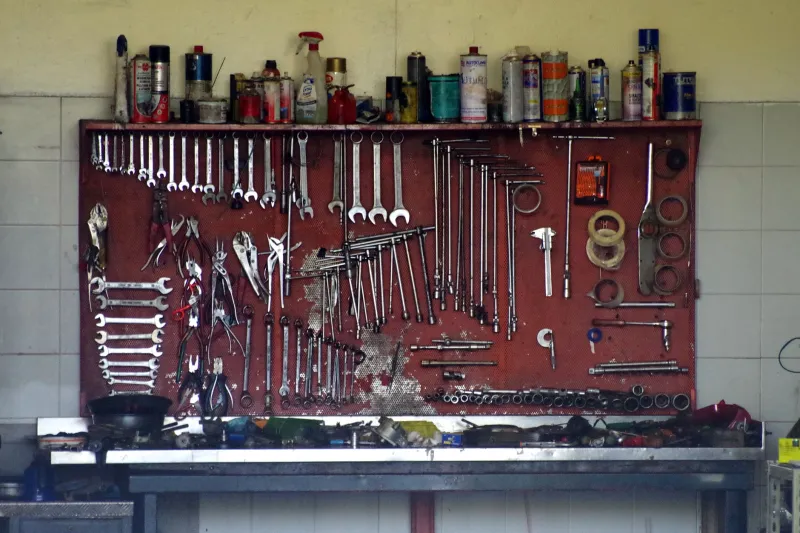
Start with a French cleat wall system. A section of plywood cut with 45-degree horizontal strips lets you hang an enormous variety of tools in a highly customizable layout. It takes up vertical space — which most people have more of than floor space — and it keeps tools visible and accessible. You can build one for under $50 in materials.
Invest in a good rolling cabinet early. Even a modest three-drawer rolling tool chest creates organization that makes ownership feel manageable rather than chaotic. It doesn't have to be a Snap-on setup. A solid mid-range cabinet will serve most homeowners well for years.
Buy in categories, not randomly. Start with a cordless drill and a circular saw — those two tools cover the majority of home improvement projects. Add a jigsaw, a sander, and a reciprocating saw as projects demand them. Don't buy a specialty tool speculatively. Let your project list drive your purchases.
Consider a battery ecosystem. Most major tool brands — Milwaukee, DeWalt, Makita, Ryobi — run their cordless tools on shared battery platforms. Picking one ecosystem and sticking to it means your batteries are interchangeable across every tool you own. That's a genuine quality-of-life improvement and a cost saver over time.
What the Shift Really Means
The move away from rental culture and toward tool ownership isn't just about money or storage. It reflects something deeper — a reconnection with the idea that skilled, hands-on work has dignity, and that the tools enabling that work deserve respect.
Craftspeople who've built careers with their hands — whether they learned their trade in Mumbai, Mexico City, or rural Kentucky — have always understood this. Your tools are part of how you show up to a job. They reflect your standards. They shape your output.
The broader American DIY movement is catching up to that understanding. At Shree Ram Hardware, we've always believed that the right tool in the right hands is one of the most powerful things in construction. We stock quality equipment across a range of budgets precisely because we want ownership to be accessible — not just aspirational.
Build better. That starts with owning the tools to do it right.